
NSF FINDERS FOUNDRY Planning · Award No. 2627489 · August–October 2026
AI As A Subject And A Personal Teaching Tool
Rhode Island high school students learn about AI in Introduction to Computing and AI (ICAI). This project asked whether AI could also personalize how each student learns it, and what teachers, parents, and students would need to trust that. Together they co-designed CuraAdapt, an AI personalization layer for the CuraCourse e-textbook platform, and then tested the design with the people it would serve.
At a glance
| Phase | Teachers | Parents | Students | What participants did |
|---|---|---|---|---|
| Discovery (August–September 2026) | 4 | 4 | 32 | Needs assessment and surveys; ranked five personalization dimensions |
| Validation (October 2026) | 4 | 3 | 35 | Watched the walkthrough; rated each need and feature (the same four teachers as Discovery) |
How we worked
Discovery
Teachers completed a needs assessment, parents a survey, and students an in-class co-design activity. Teachers and parents each produced a ten-item needs registry.
Design
The team turned the needs into a 15-feature specification. CuraCourse built 21 wireframes and the walkthrough video; teachers and the project's co-PIs reviewed and revised them.
Validation
Teachers, parents, and students watched the walkthrough and rated whether the design met each need. Teachers also rated what a one-year build should include.
What stakeholders asked for
- Teachers most wanted support for widely different reading and ability levels: 3 of 4 rated it essential, and both Central Falls teachers asked for home-language support for multilingual learners. All four rated their lack of visibility into how students use AI a major or critical problem.
- Students ranked personalization by their interests first (first choice for 16 of 32), then career goals. They asked for shorter explanations (25 of 32), examples tied to their interests (23), and a tutor that gives hints rather than answers (20). Only 14 of 32 trusted that their personal information would be protected.
- Parents unanimously supported teaching how AI works. Their main concerns were clear rules about what data are collected and used, and teachers staying in control of what each student sees.
The design: a visible control on each AI path
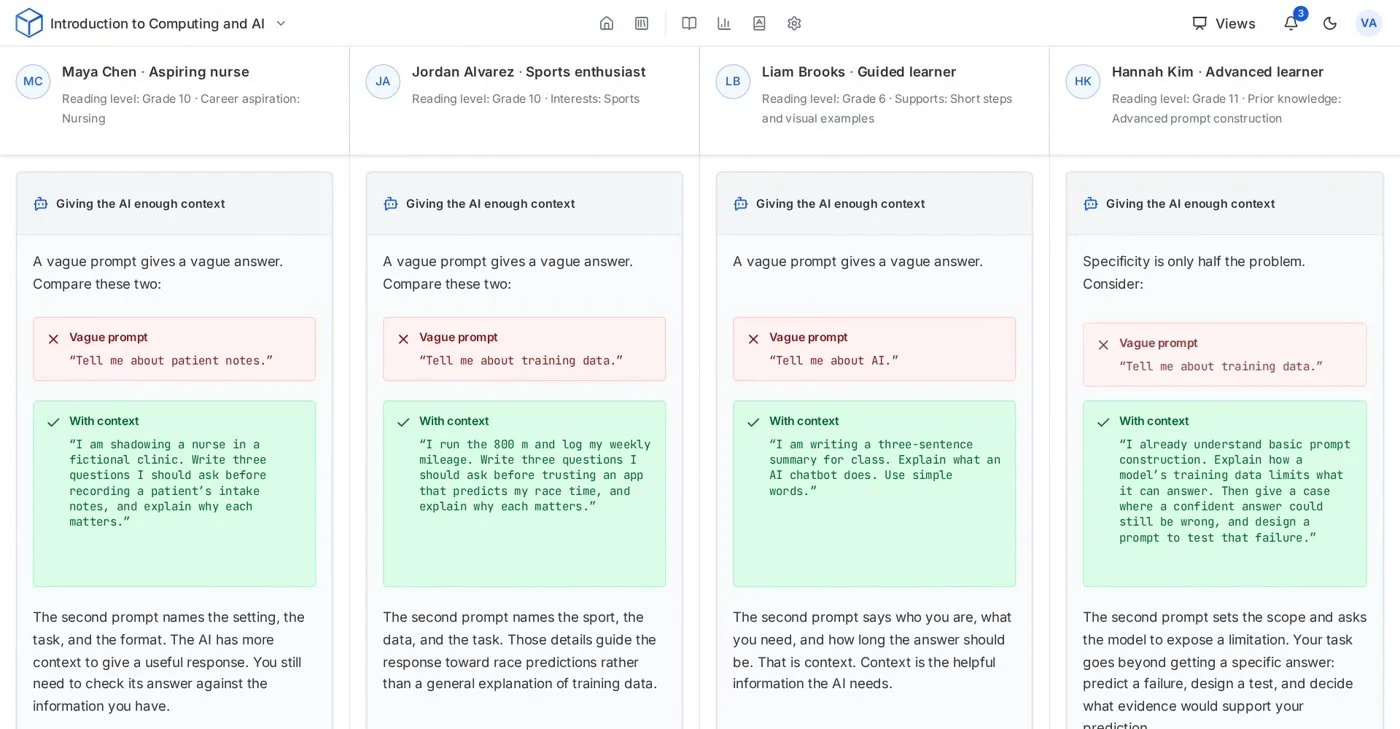
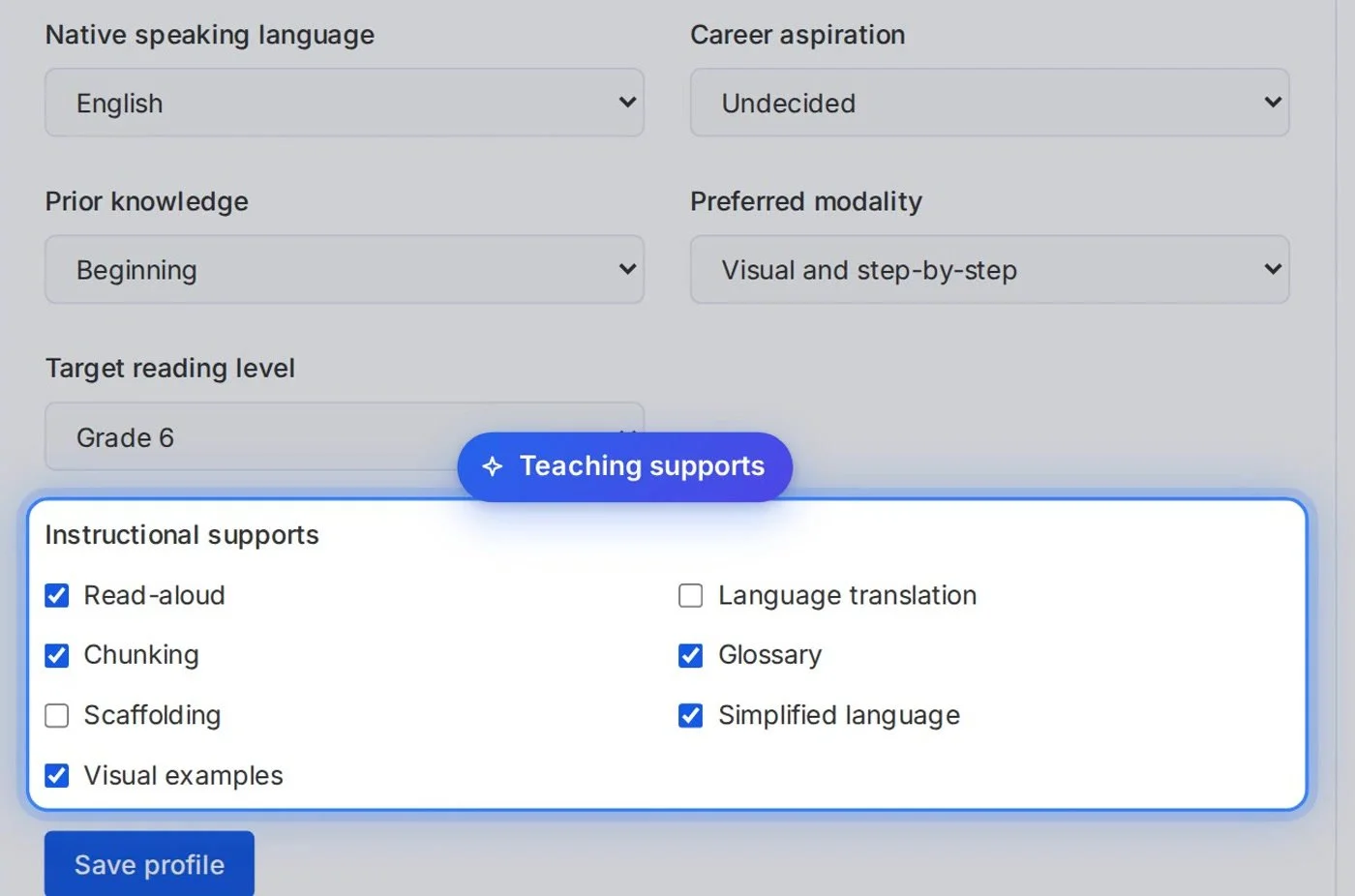
CuraAdapt builds a five-part learner profile: interests, career goals, prior knowledge, reading and ability level, and preferred format. The profile drives three AI paths, and each path has its own control.
| AI path | What the student gets | Control |
|---|---|---|
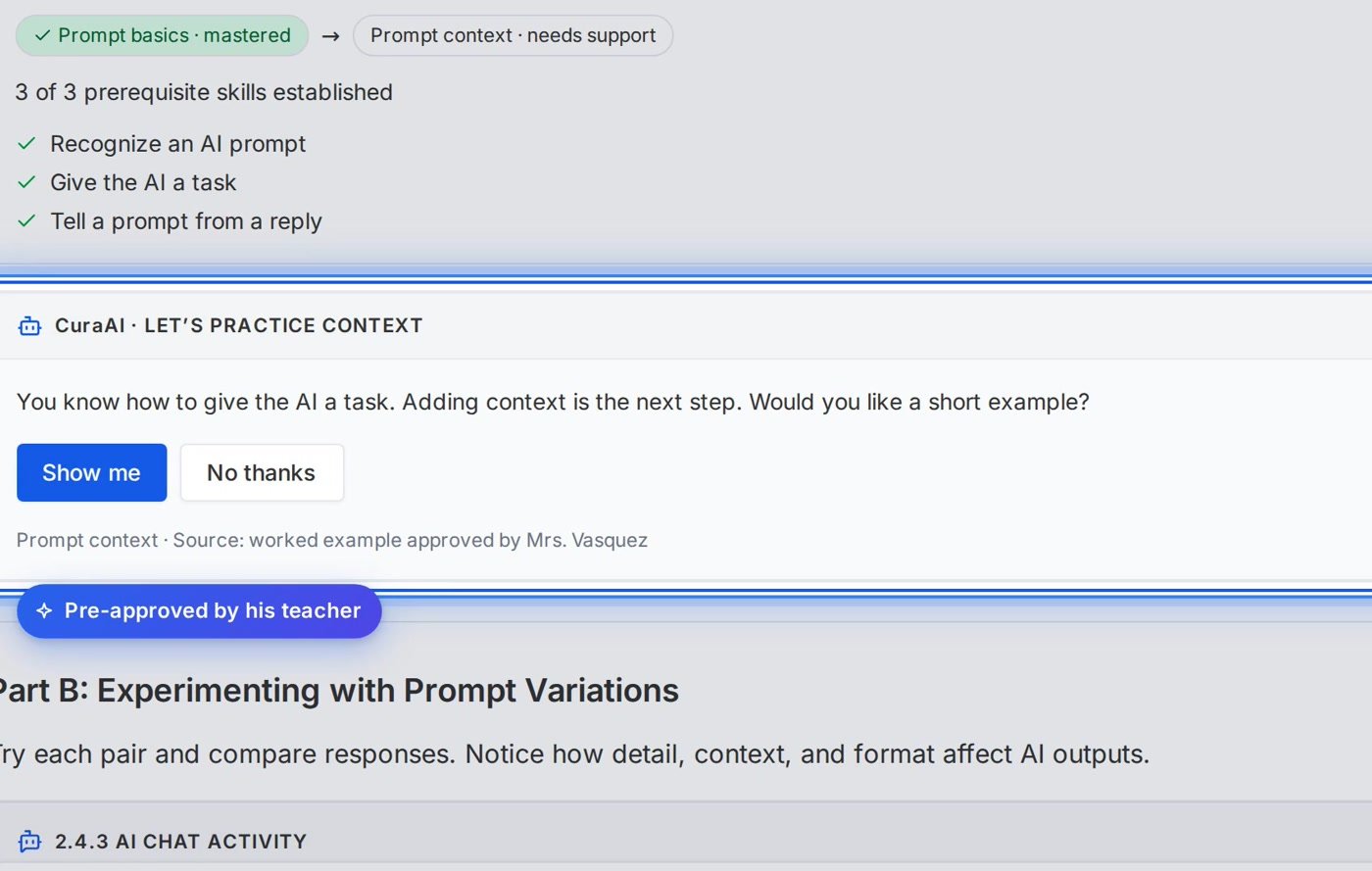
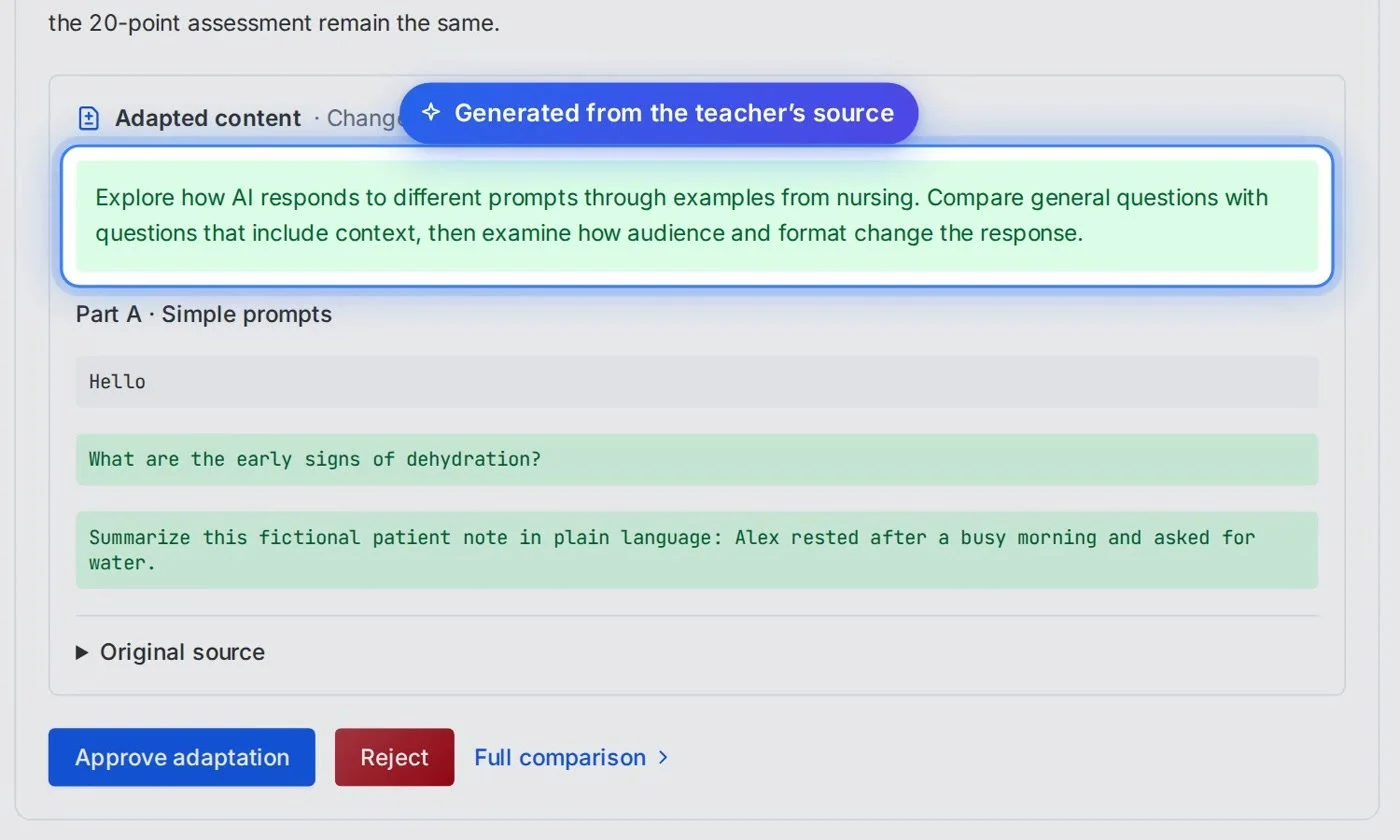
| Lesson generation | Passages, examples, and practice tied to the student's profile | The teacher approves each variation before any student sees it; unapproved sections show the standard lesson |
| Reteaching | Help offered when a check shows a missed concept | Generated in real time from teacher-approved course material; offered, never forced |
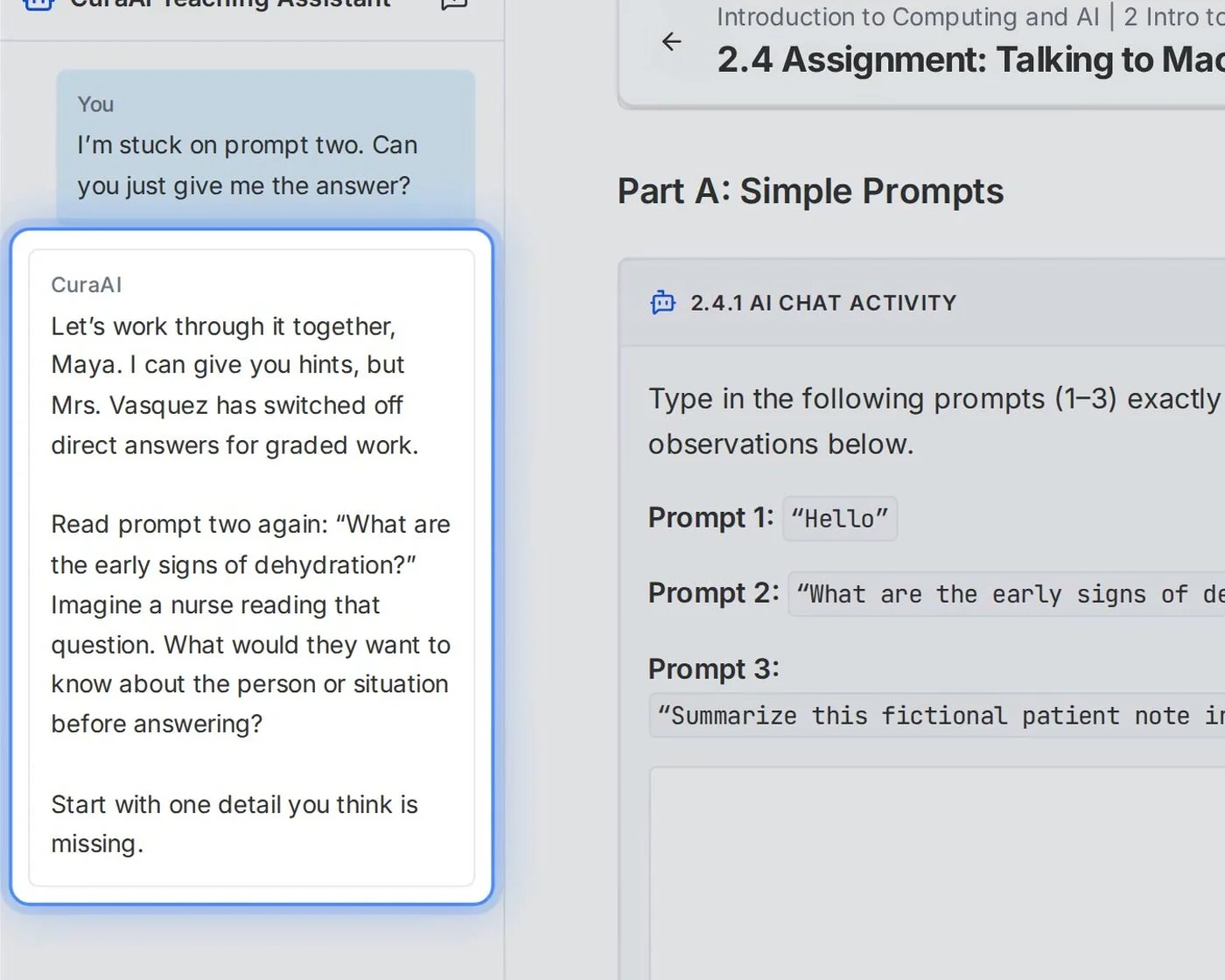
| AI tutor | Step-by-step hints during the lesson | Teacher-set rules for each lesson; no answers to graded work; every exchange logged |
What Validation found
All four teachers strongly agreed they are ready to pilot the design, and they rated 35 of their 40 needs met. Between Discovery and Validation, the same teachers' comfort with AI adapting content rose from 4.25 to 4.75 of 5, and their trust in data protection from 3.75 to 4.00. Parents rated 22 of 30 needs met, and all three would join the parent portal. Of 35 students in three schools, 29 would choose the adapted course next semester and 29 would rather have lessons built around their interests.
The open problem. Students' trust that their personal information is protected was the lowest-rated item in both rounds: 3.25 of 5 at Discovery and 3.34 at Validation. Fifteen of 35 students worried the platform would know too much about them, and five objected, unprompted, to parents reading their AI conversations. Raising student trust is a design target for the next phase.
From stakeholder need to design change
| What stakeholders told us | Evidence | Design change |
|---|---|---|
| Teachers can review only a limited amount of AI-generated content. | Review becomes unworkable above 10–25 items a week (2 of 4 teachers) or 26–50 (2 of 4); 3 of 4 would use auto-approval and bulk approval. | Review sized to 10–50 items a week, with bulk and concept-level approval and auto-approval of repeats. Unapproved sections show the standard lesson. |
| Teachers cannot see how students use AI today. | All 4 teachers rated this a major or critical challenge (3 critical). | All tutor exchanges are logged; teachers see flags and a summary first, with the full transcript one click away. |
| The tutor should give hints, not answers. | 20 of 32 students asked for hints rather than answers; 25 of 35 agreed the tutor should refuse graded answers; all 4 teachers want this under teacher control. | The tutor never gives answers to graded work and follows teacher-set rules for each lesson. |
| Help a struggling student without singling them out. | 30 of 35 students prefer being offered extra practice; 20 of 35 would mind at least a little if a prompt appeared on screen in class. | Reteaching is offered, not imposed, and appears in-line rather than as a pop-up. Teachers set each concept's mastery threshold. |
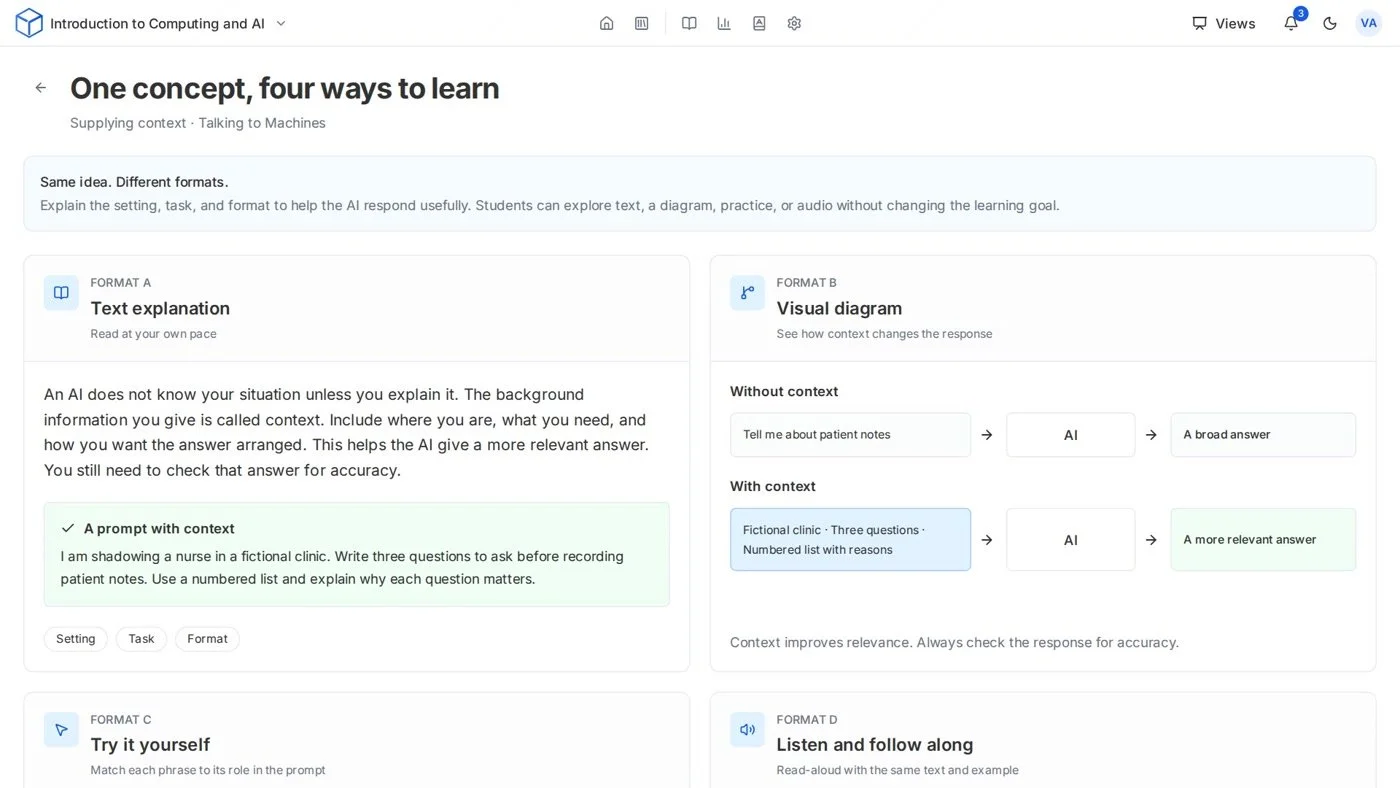
| Reading and language support matter most to teachers; students want help with hard words. | 3 of 4 teachers rated reading and ability level essential. A hard word explained in place would help a lot for 21 of 35 students; students split on read-aloud (11 a lot, 12 not at all). | In-line word explanations come first, with translated directions, sentence starters, and executive-function supports. Read-aloud is optional. |
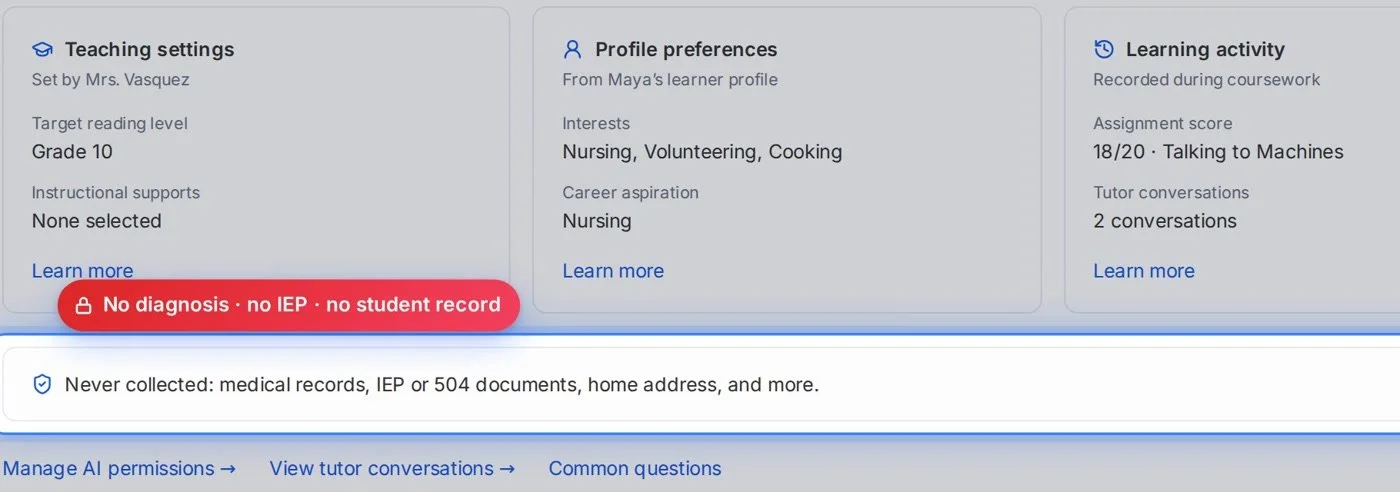
| Who controls what between teachers and parents is unclear. | 3 of 4 teachers rated their control of parent access partially met or unmet; 5 students objected to parent access. | One shared statement of who controls what; parent access set in the teacher's roster; students told before first use what parents can see. |
| Building concept maps would take too much teacher time. | No teacher placed concept-map authoring in year one; all 4 accept a shared starter map. | URI supplies an editable starter concept map for each unit. |
Needs registries and Validation ratings
Each need is written in the stakeholders' own words from Discovery. At Validation, each respondent rated whether the revised design addressed it.
Teacher needs (4 teachers: Central Falls 2, East Providence 1, Ponaganset 1)
| # | Need | Met | Partially | Unmet |
|---|---|---|---|---|
| 1 | One coherent ICAI course in one place, not materials scattered across sites | 3 | 1 | |
| 2 | Content that adapts to the individual student without me rewriting anything | 3 | 1 | |
| 3 | I set reading level, accommodations, and language myself; no diagnosis or IEP in the system | 4 | ||
| 4 | More than one way into the same concept, for students who don't learn from a block of text | 4 | ||
| 5 | Nothing AI-generated reaches a student until I have approved it | 4 | ||
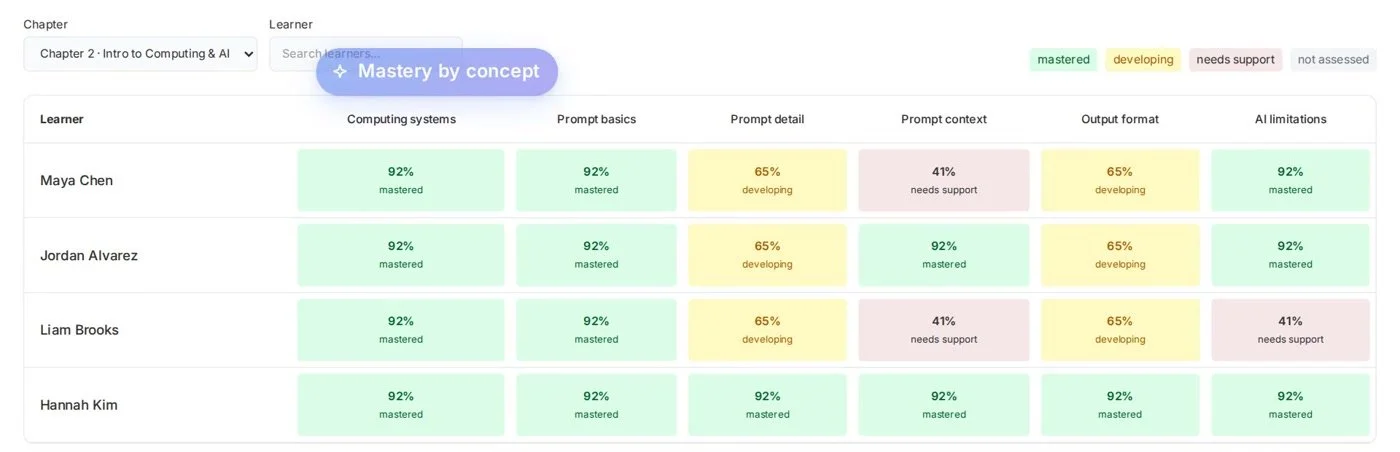
| 6 | Where each student stands concept by concept, not one score per assignment | 4 | ||
| 7 | When a student misses a concept, something useful happens in the moment, from material I approved | 4 | ||
| 8 | Tell me who is struggling before the unit test, and show me the evidence | 4 | ||
| 9 | A tutor my students can use that follows boundaries I set, with every exchange visible to me | 4 | ||
| 10 | I decide per student what a parent can see, and I can explain why a lesson differed | 1 | 2 | 1 |
| Total (40 ratings) | 35 | 4 | 1 |
Parent needs (3 parents: one each from Central Falls, East Providence, and Ponaganset)
| # | Need | Met | Partially | Unmet |
|---|---|---|---|---|
| 1 | Be added to my child's course and see what they are actually working on | 3 | ||
| 2 | Understand why the course showed my child something different from another student | 2 | 1 | |
| 3 | See my child's conversations with the AI, in full | 2 | 1 | |
| 4 | Nothing about a disability, diagnosis, or plan sitting in a vendor's system | 3 | ||
| 5 | Support my child without singling them out on their own screen | 3 | ||
| 6 | Change the examples and the reading level, but not what is taught or graded | 2 | 1 | |
| 7 | The AI my child talks to has limits someone set on purpose | 2 | 1 | |
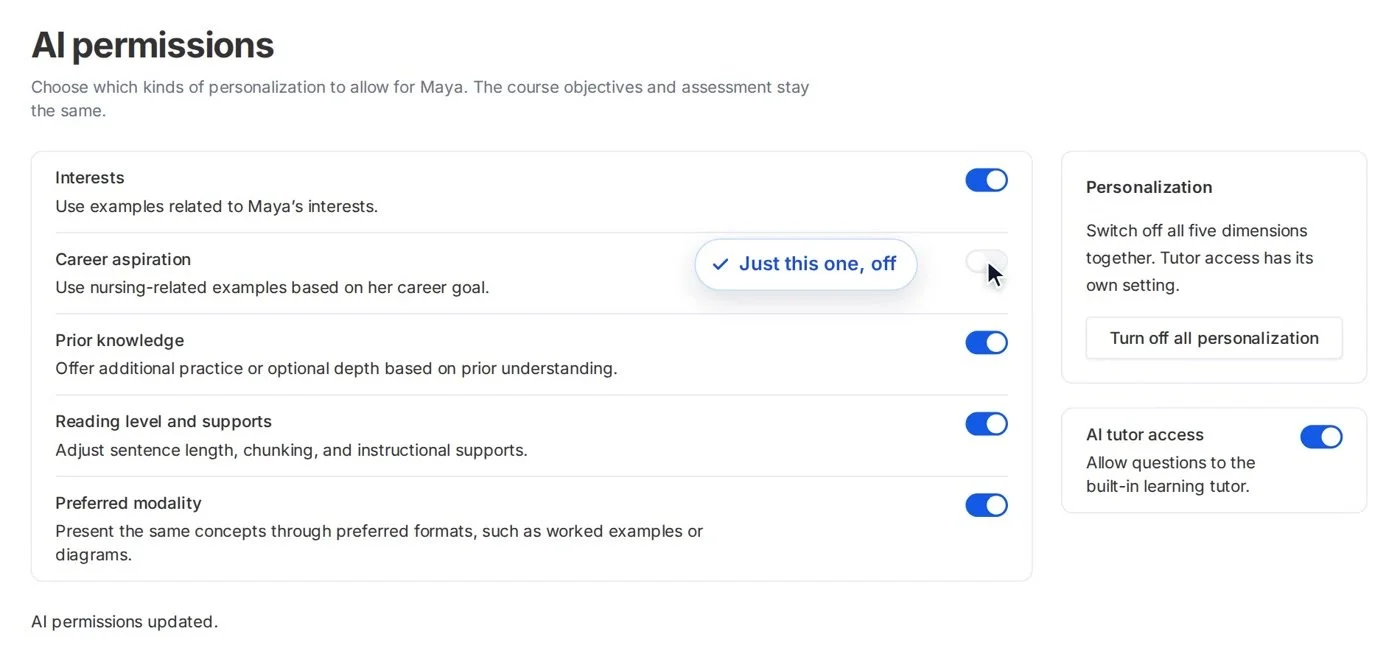
| 8 | Turn off specific kinds of personalization without my child losing the course | 2 | 1 | |
| 9 | Know what is collected, how long it is kept, and that it is not sold or used to train a model | 2 | 1 | |
| 10 | When my child struggles, the course helps rather than just recording the failure | 1 | 2 | |
| Total (30 ratings) | 22 | 6 | 2 |
Both unmet parent ratings came from one parent. In the revised design, teachers enable transcript access for each student, and the portal states that data are never sold, used for advertising, or used to train models.
Key wireframes
Six of the screens stakeholders rated at Validation. All learners and teachers shown are fictional.

What comes next
The Planning project produced the validated design for a proposed 12-month FINDERS FOUNDRY Development project: build the CuraAdapt minimum viable product with the same co-design partners, then pilot it with about 150 students in six Rhode Island high schools in Fall 2027. Pilot and comparison sections would take the Generative AI Literacy Assessment Test before and after the course, and go/no-go decisions would rest on safety, accuracy, teacher workload, student adoption, and learning evidence. The six proposed partner schools are Central Falls, East Providence, Ponaganset, Narragansett, Chariho, and Davies Career and Technical high schools.
Downloads
Results
- Planning evidence at a glance (PDF, 1 page)
- Needs registries and Validation ratings (PDF, 1 page)
- Key wireframes (PDF, 1 page)
- De-identified aggregate Discovery and Validation results (Excel)
Instruments
- Teacher needs assessment (Discovery)
- Parent and guardian survey (Discovery)
- Student co-design activity (Discovery)
- Educator Validation survey
- Parent and guardian Validation survey
- Student Validation survey
Publications
- "AI-Assisted Personalized Learning Needs Assessment With K-12 Students, Teachers, and Parents," in preparation for the 2027 IEEE Frontiers in Education Conference.
Team and partners
University of Rhode Island: Victor Fay-Wolfe (PI), Department of Computer Science; Jay Fogleman (Co-PI), School of Education; Kaleel Mahmood (Co-PI), Department of Computer Science.
Technology partner: CuraCourse, Inc. (Joe Mazzone), which built the wireframes and walkthrough video.
Partner teachers: Patricia Piros (East Providence High School), Mary Klein (Ponaganset High School), and Troy Silva and Alison Murray (Central Falls High School). Parents and guardians from all three districts served as paid co-designers. We thank the students of all three schools for their candid feedback.
This material is based upon work supported by the National Science Foundation under Grant No. 2627489. Any opinions, findings, and conclusions or recommendations expressed in this material are those of the authors and do not necessarily reflect the views of the National Science Foundation. Stakeholder data were collected under University of Rhode Island IRB protocol IRB2526-336.